Hobbit Holes on Airbnb:
A Witness to Architecture in Transition
Link to Article on Subjekt.no
English Translation:
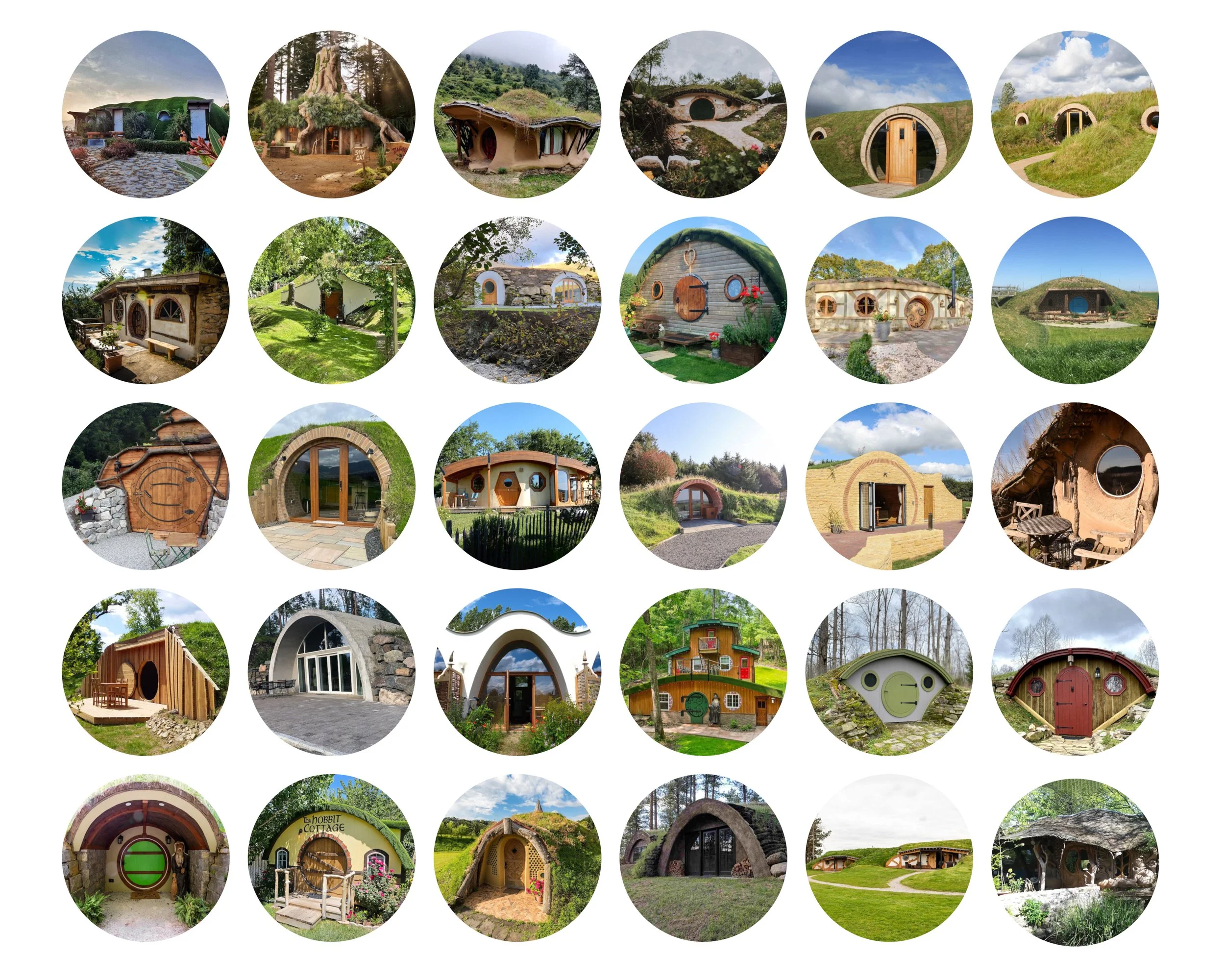
Would you like to spend a weekend relaxing in a hobbit hole? If so, you are not alone. The hosts of NRK’s popular podcast, Erlend and Steinar, mention in today’s episode that this is exactly what they would like to do. What they do not know is that there are now countless listings on Airbnb featuring fully booked hobbit holes—small, grass-covered, round houses inspired by Tolkien’s fantasy world. The question I ask myself is this: what can today’s architects learn from the popularity of hobbit holes?
An Updated Postmodernism
In everyday speech, modernism and postmodernism are often confused. To put it simply: modernism sought to eliminate symbols, while postmodernism brought them back. This began in 1968, when two American architecture professors at Yale took their students to Las Vegas to study hotels and casinos such as Caesar’s Palace and Aladdin’s Lamp. There, they discovered that capitalism had already proven what architects refused to admit: people want symbolism in architecture. (Source: Robert Venturi, Denise Scott Brown & Steven Izenour, Learning from Las Vegas (1972))
Sixty years later, I am not sitting in a car in Nevada, but in front of a screen, scrolling through Airbnb. Here too, one can read what people actually desire in architecture.
Market Niches
Where the hotels in Las Vegas were enormous buildings housing thousands of tourists, Airbnb represents the opposite: small units for a couple or a small group. The platform gives visibility to individual actors who would otherwise remain invisible. Hotels must appeal broadly to fill all their rooms, while Airbnb units can take far greater architectural risks in order to reach small market niches.
The result is an enormous range of experimental offerings: a bright pink dollhouse, Shrek’s swamp house, or a small house hoisted up by a crane, inspired by Pixar’s film Up.
Small Scale and Tactility
From these examples we see that references to popular culture sell well, just as they did in Las Vegas, where many of the hotels and casinos referred to films produced by Disney and Hollywood. Tourists wanted to travel into the world they saw on screen. Exactly the same today—only now it is from Netflix to Airbnb.
The difference is that the expression is now far more intimate. Where Las Vegas worked with eye-catching neon signs and monumental forms, Airbnb architecture is about materiality and atmosphere: interiors, surfaces, craftsmanship, and everyday objects.
Arts and Crafts
Here, the hobbit holes are a particularly good example. It is precisely the intimacy and the feeling of wood, the warmth of the fireplace, and the creaking of the door that draw guests into Tolkien’s world. Tolkien himself was inspired by William Morris and the Arts and Crafts movement of the late nineteenth century, which emphasized local craftsmanship in response to industrialization. Details were paramount.
I wrote to a couple of the owners of the hobbit holes, and they told me that it was often they themselves, or craftsmen they knew, who had carried out the construction. With curved walls and round doors, everything has to be built on site. Since this is expensive, people often do it themselves and frequently document the process on social media, which later functions as marketing for the rental. This also means that each hobbit house is unique.
Simplicity and Complexity
Postmodern architects of the 1970s drew symbols from history but often reduced them to abstract forms—a Greek pediment became a simple concrete triangle. Partly this was about economics: hotels in Las Vegas prioritized contrast and visibility over details that could not be seen from the highway anyway. But it was also related to their sources of inspiration: Disney films such as Aladdin were themselves highly abstracted.
Today, the references are more detailed. The Lord of the Rings is a good example, depicting a world described down to the embroidery on the inside of costumes. Consequently, guests also expect Airbnb houses inspired by modern popular culture to offer a richer expression—with textures, ornamentation, and small narratives embedded in the materials.
Fantasy as a Response to the Architecture Uprising
The Architecture Uprising often lumps modernism and postmodernism together—and that is understandable. Even though postmodernism sought to reintroduce tradition and symbolism, it was often done on a theoretical level that went over most people’s heads. They want to return to the time before modernism. I would argue, however, that this is too simplistic. Instead, today’s architects should learn from the hobbit holes on Airbnb, rather than from the outdated hotels of Las Vegas.
For in the fictional universes that abound in our time, there exists a wealth of new styles and symbolic languages from which architects can draw inspiration. Perhaps a new generation of architects can thus respond to the longings of the uprising—without locking themselves into premodern dogmas.